A commercial driver’s license, or CDL, is required for anyone wanting a career driving large trucks or buses in Ohio and across the United States. Before an applicant can legally drive one of these vehicles for pay, the applicant must pass the Ohio CDL skills test, the state’s hands-on evaluation of a driver’s ability to control the vehicle safely. Before test day, applicants should know what the test includes, what examiners look for, and how to prepare.
What the Test Covers
Ohio’s Class A CDL skills test has three parts, given in a fixed order:
The applicant must pass each segment before moving to the next. A failure in the pre-trip inspection ends the test before the applicant drives at all, and a failure in basic vehicle control ends the test before the road portion begins.
Part One: The Pre-Trip Vehicle Inspection
The pre-trip inspection has a 30-minute time limit. The applicant points to or touches each safety-critical item and explains its purpose aloud to the examiner.
The test starts inside the cab and covers dashboard indicators, emergency equipment, the windshield, wipers and washers, the heater and defroster, the horn, and the parking and service brakes, including the air-brake or hydraulic-brake check. An applicant who fails this brake check does not proceed further; the test ends on the spot.
Outside the cab, the applicant inspects the engine compartment, one axle’s tires, rims, lug nuts, suspension, brake lines, steering components, and fluid levels, as well as the side and rear of the vehicle. For combination vehicles used in Class A testing, the inspection also covers the air and electric lines, the fifth-wheel or pintle-hook coupling, locking devices, landing gear, and reflective tape. A lights check follows, covering turn signals, four-way flashers, high and low beams, and marker and brake lights.
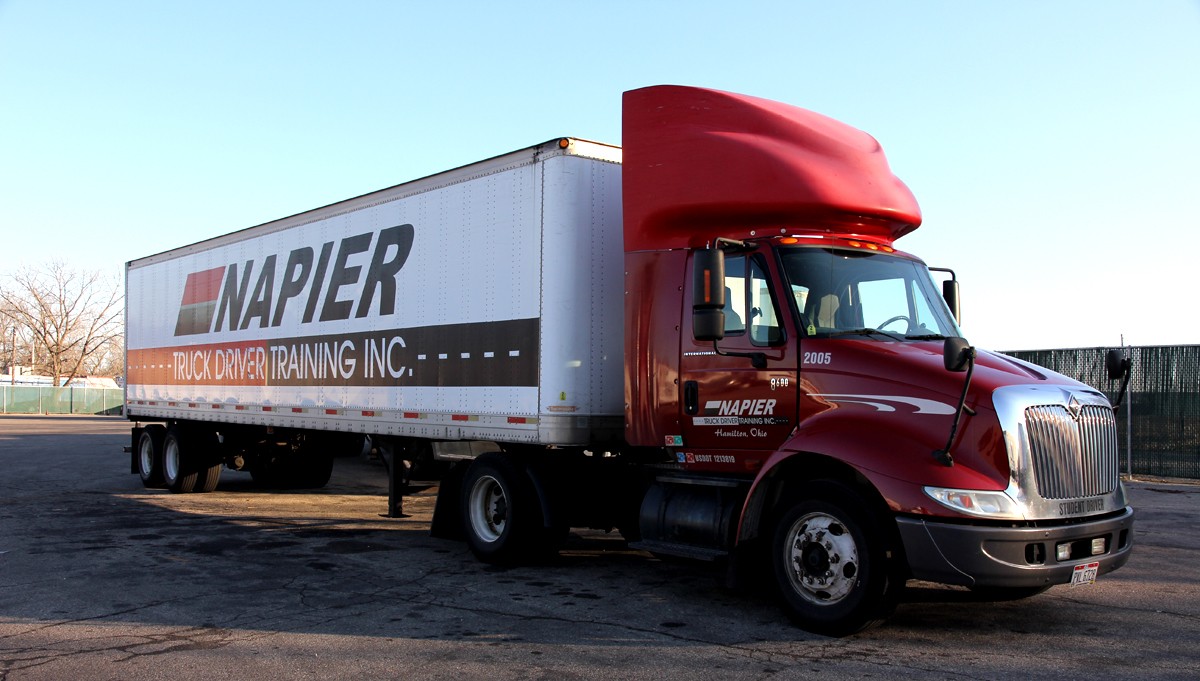
Ohio does not publish a fixed point value for each item. Instead, an applicant passes when negative points stay under 20 percent of the total available. Napier’s Full-time Class A CDL Training program includes structured practice on this checklist, using the same type of vehicle used for testing.
Part Two: Basic Vehicle Control
Basic vehicle control, sometimes called basic maneuverability, has a 40-minute time limit. Ohio currently uses four exercises: forward stop, straight-line backing, forward offset tracking, and reverse offset backing. Older CDL manuals mention parallel parking or alley dock backing, but neither is part of Ohio’s current four-exercise list.
Examiners score each exercise on pull-ups, encroachments (touching or crossing a boundary line or cone), looks, and final position. Straight-line backing allows one free pull-up and one free look. Reverse offset backing allows two free pull-ups and two free looks. An applicant passes this segment if they have no more than 12 total errors.
Common reasons applicants fail this segment include touching or crossing a boundary line, using too many pull-ups or looks, stopping during forward offset tracking, ending in the wrong position, opening the cab door while the vehicle moves, or forgetting to set the parking brake. Any of these can end the test at the examiner’s discretion.
Part Three: The Road Test
Unlike the first two parts of the test, the road test has no fixed time limit. However, the test has a total time limit of three hours. The applicant drives a pre-approved route covering turns, intersections, urban traffic, lane changes, expressway driving, curves, railroad crossings, and traffic-sign recognition.
Examiners score lane use, steering, mirror and traffic checks, signal use, braking, and speed control. An applicant only passes if they have no more than 30 total errors, but a moving traffic violation or an avoidable accident results in an automatic failure, regardless of the error count.
Before Scheduling the Test
Two requirements must be met before test day:
- The applicant needs a valid Ohio commercial learner’s permit, or CLP, held for the required minimum period (14 days).
- The applicant must complete Entry-Level Driver Training, or ELDT, the federally required training curriculum for all new CDL applicants. The training provider submits ELDT completion electronically, and the skills test cannot be scheduled until that record is on file. Napier’s CDL training programs cover ELDT as part of the curriculum, whether a student enrolls full-time or through the Weekend CDL Training program.
Once requirements are met, an Ohio Bureau of Motor Vehicles (BMV) examiner or an approved third-party examiner administers the test. Document requirements for the test, such as a medical certificate or proof of vehicle registration and insurance, can vary by test site, so applicants should confirm requirements with their specific location. Ohio’s current policy requires a two-day wait before an applicant can retest after a failure.
Preparing for Each Segment
A few habits can be crucial to passing the test. Applicants should rehearse the pre-trip checklist out loud, in the same vehicle class used for testing, until the explanations come without hesitation. During practice drives, applicants should set the parking brake at every stop and keep three points of contact while exiting the cab, since both habits are scored directly. Active mirror and traffic checks, early signals, and controlled speed should become routine on every practice trip, not only before the road test. Don’t practice these until you get them right once; practice them until it feels almost impossible to get them wrong.
Before scheduling, applicants should confirm their ELDT completion is on file, confirm they’ve met the CLP hold time, and check the vehicle and document requirements at their specific test site.
Next Steps
Applicants preparing for the Ohio Class A CDL skills test can review Napier’s Full-time Class A CDL Training program or the Weekend CDL Training program for details on classroom and behind-the-wheel preparation. Students weighing the cost of training can review tuition assistance and financial aid options, and graduates can see how job placement assistance works at Napier.
Frequently Asked Questions
How long does the full Ohio CDL skills test take?
The pre-trip inspection has a 30-minute time limit, and basic vehicle control has a 40-minute time limit. Ohio does not publish a fixed duration for the road test.
What happens if you fail the pre-trip inspection?
The test ends immediately. The applicant does not move on to basic vehicle control or the road test due to safety concerns.
Does Ohio still test parallel parking or alley dock backing?
No. Ohio’s current basic vehicle control segment uses four exercises: forward stop, straight-line backing, forward offset tracking, and reverse offset backing.
How many mistakes can you make on CDL test and still pass?
Basic vehicle control allows up to 12 total errors, and the road test allows up to 30. A moving violation or avoidable accident automatically fails the road test.
What training is required before scheduling the CDL skills test?
Applicants must complete Entry-Level Driver Training (ELDT) and hold a valid Ohio commercial learner’s permit for the required period.
How soon can you retake CDL exam after a failure?
Ohio’s current policy requires a two-day wait before retesting.
Do document requirements differ by test site?
Yes. Requirements such as a medical certificate or proof of vehicle registration and insurance vary by location, so applicants should confirm requirements with their specific site.