Paying for CDL school is one of the largest hurdles for many future truck drivers. Luckily, students have options when paying for training. Some students qualify for government programs like Ohio’s Workforce Innovation and Opportunity Act (WIOA) Dislocated Worker Program; veteran students may be able to use military benefits; and other students can take out private student loans or pay for training out of pocket.
Many students use tuition reimbursement from trucking companies to pay for training. Tuition reimbursement programs can bring the cost of training down to little or nothing, but they come with rules and requirements that every student should understand before moving forward.
What Is Tuition Reimbursement?
Tuition reimbursement is a program where a trucking company pays a new driver back for the cost of CDL school after the driver starts working for the company.
The money does not typically arrive all at once. Most carriers pay it back in small amounts over time, usually in set amounts added to each paycheck or monthly payments spread over a year or more. Because of this, students usually have to cover tuition first. That money often comes from savings or a loan. The driver then earns back their investment on the job.
Each carrier has its own rules regarding tuition reimbursement. The total amount, the payment schedule, and the length of the work commitment can vary from carrier to carrier. Some programs cap payments at a set dollar amount; others only pay drivers who stay in good standing and meet safety standards. Two programs that sound alike on a recruiting flyer can work very differently once a driver is on the road.
How to Apply for Tuition Reimbursement
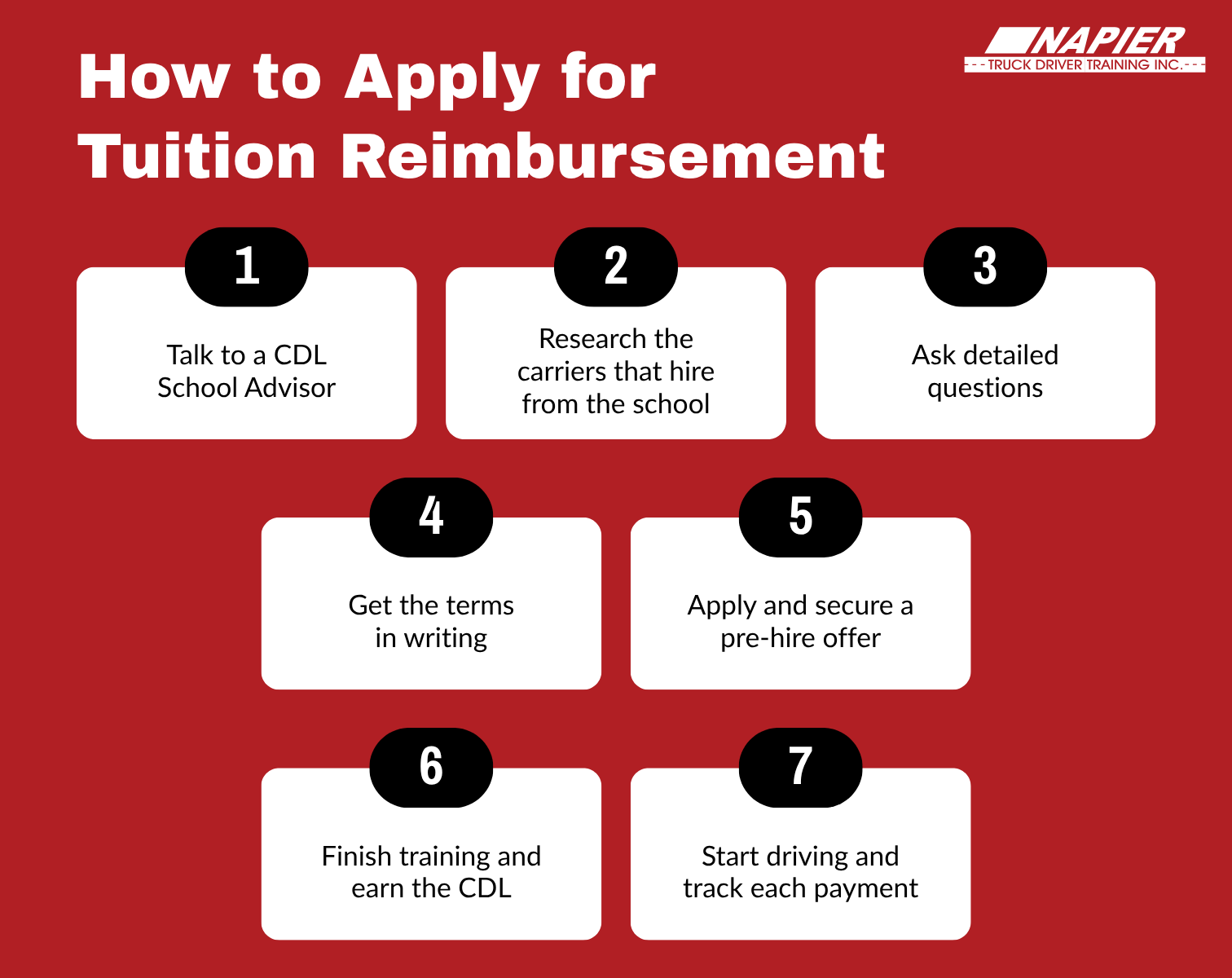
Finding and using a reimbursement program takes some planning. These steps cover the usual path from first questions to first payment.
- Talk to a CDL school advisor. Schools work closely with carriers and know which ones offer reimbursement. At Napier, admissions reps meet with students one-on-one to go over tuition assistance options, including reimbursement, WIOA funding, and loans.
- Research the carriers that hire from the school. Many schools host recruiters on campus. Napier holds regular recruiter visits where students can meet carriers and ask about their programs face to face.
- Ask detailed questions. Students should find out the total amount paid back, how often payments come, how long the commitment lasts, and what happens if they leave early.
- Get the terms in writing. A recruiter’s promise is not a contract. Students should read the full agreement and ask about anything that is unclear before signing.
- Apply and secure a pre-hire offer. Reimbursement is almost always tied to being hired. Many students line up a pre-hire letter before they finish school through programs like Napier’s job placement assistance.
- Finish training and earn the CDL. Students should keep copies of their enrollment agreement, payment receipts, and proof of completion. Carriers often ask for these records before payments begin.
- Start driving and track each payment. Drivers should check their pay stubs to make sure reimbursement shows up on the schedule listed in the agreement.
After Graduation: The Work Commitment
Tuition reimbursement is not a gift; it’s a trade. The carrier pays for training, and in return the driver agrees to stay with that company for a set amount of time. That period is often a year or longer, though the length depends on the carrier.
Drivers who leave before the end of their commitment usually stop receiving payments. Under many agreements, that is the only loss. Other agreements require the driver to pay back some or all of the money already received. In company-sponsored programs, where the carrier paid the school upfront, a driver who leaves early may owe a portion or all of the training cost. Some contracts also add fees, and unpaid balances can be sent to collections.
The first year of driving is often the hardest. New drivers may spend weeks away from home, get longer routes, or feel new-job stress as they build experience. These are common reasons drivers think about leaving early; no new driver can say there’s no chance they will be affected by any of them. Students should ask about home time, pay structure, and the type of freight they’ll be hauling before they commit to a tuition reimbursement program, not after.
A good career fit matters more than the dollar amount of the reimbursement. A smaller payback from a carrier that matches a driver’s goals is often worth more than a larger one from a company the driver will want to leave in three months. Once the commitment is complete, drivers are usually free to move on. With access to a job placement team like Napier’s, drivers can usually find work with a new carrier relatively quickly.
Is Tuition Reimbursement the Right Choice?
For some, tuition reimbursement is a terrific option for paying for CDL training. It lets students choose their own school and earn back what they spent once they start driving. If students understand and are prepared for the trade they are making, they can explore this tuition option as a legitimate way to get their CDL.
Explore Tuition Assistance Options With Napier
Every student’s situation is different. Napier’s admissions team can walk anyone through the payment options they may qualify for, including tuition reimbursement, WIOA funding, veterans’ benefits, and student loans. They can also explain which carriers recruit Napier graduates and how their programs compare.
Anyone interested, and anyone helping them decide, can reach out with any questions they may have!
Frequently Asked Questions
What is sponsored CDL training?
Sponsored CDL training is when a trucking company pays for a student’s training upfront, either at its own school or a partner school. In return, the student agrees to drive for that company for a set amount of time.
Is paid CDL training worth it?
Yes, for students who are ready to commit to one carrier for the full length of the agreement. Students should compare pay, home time, and repayment terms before signing to make sure the deal fits their goals.
How can I get my CDL for free?
Most free CDL training comes from tuition reimbursement, company sponsorship, or government programs like WIOA. A CDL school advisor like the ones at Napier can help students find out which of these they qualify for.
Is sponsored training the same as paid CDL training?
Not exactly. Sponsored training means the carrier pays the school upfront, while “paid CDL training” is a broader term that can also mean tuition reimbursement, where the student pays first and the carrier pays them back later.
Is there still a truck driver shortage?
Many carriers still report trouble hiring and keeping qualified drivers. That demand is a major reason so many companies offer tuition reimbursement to attract new drivers and keep them on staff.