The choice of truck driving school shapes a driver’s entire career. Recent U.S. Department of Transportation enforcement removed thousands of non-compliant schools from the federal registry, and not all CDL programs deliver the same quality training. The wrong school costs more than money. It leaves students unprepared for the realities of professional driving.
This guide covers how to verify school credentials, spot warning signs, compare programs, and choose training that leads to real career success.
Step 1: Understand Why the Choice of Truck Driving School Matters
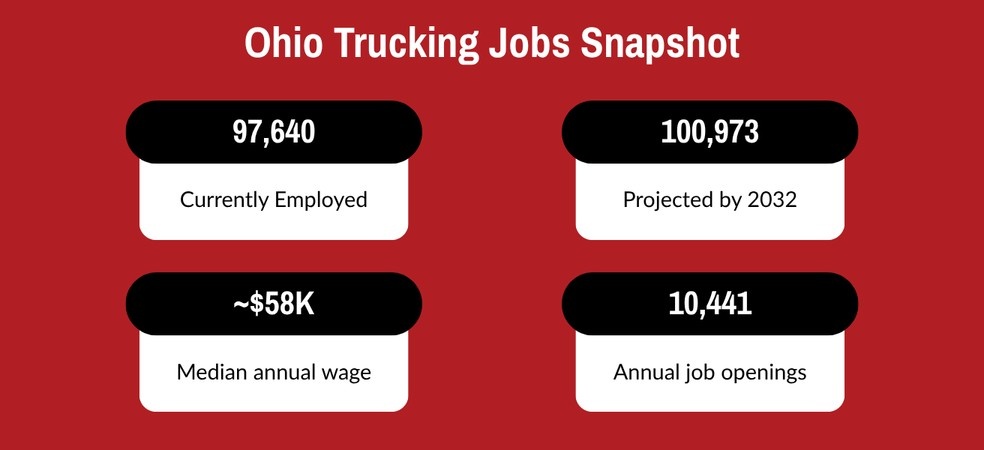
The school a student chooses affects earning potential and career path. According to the Ohio Labor Market Information office, Ohio employs about 97,460 heavy and tractor-trailer truck drivers, with more than 10,400 job openings projected each year through 2032. Nationally, the Bureau of Labor Statistics projects about 237,600 openings per year between 2024 and 2034.
Graduates from quality programs tend to receive more job offers and higher starting pay. Strong schools maintain carrier relationships that lead to:
- Recruiter visits and on-site hiring events
- Access to specialized routes such as flatbed and hazmat
- Advancement pathways including trainer positions
What Quality Training Covers
Beyond basic vehicle operation, a thorough program prepares students for:
- Trip planning and route management
- Cargo securement and load verification
- Federal Hours of Service regulations
- Pre-trip inspections and daily compliance
- Defensive driving and emergency response
ELDT: The Federal Training Standard
The Federal Motor Carrier Safety Administration’s (FMCSA) Entry-Level Driver Training (ELDT) regulations took effect in February, 2022. They apply to:
- First-time Class A or Class B CDL applicants
- License upgrades
- Passenger, hazardous materials, and school bus endorsements
ELDT requires studying theory subjects plus behind-the-wheel instruction. Students must score at least 80 percent on these assessments. Schools must submit completion records to the Training Provider Registry.
Step 2: Verify School Credentials and Quality Standards
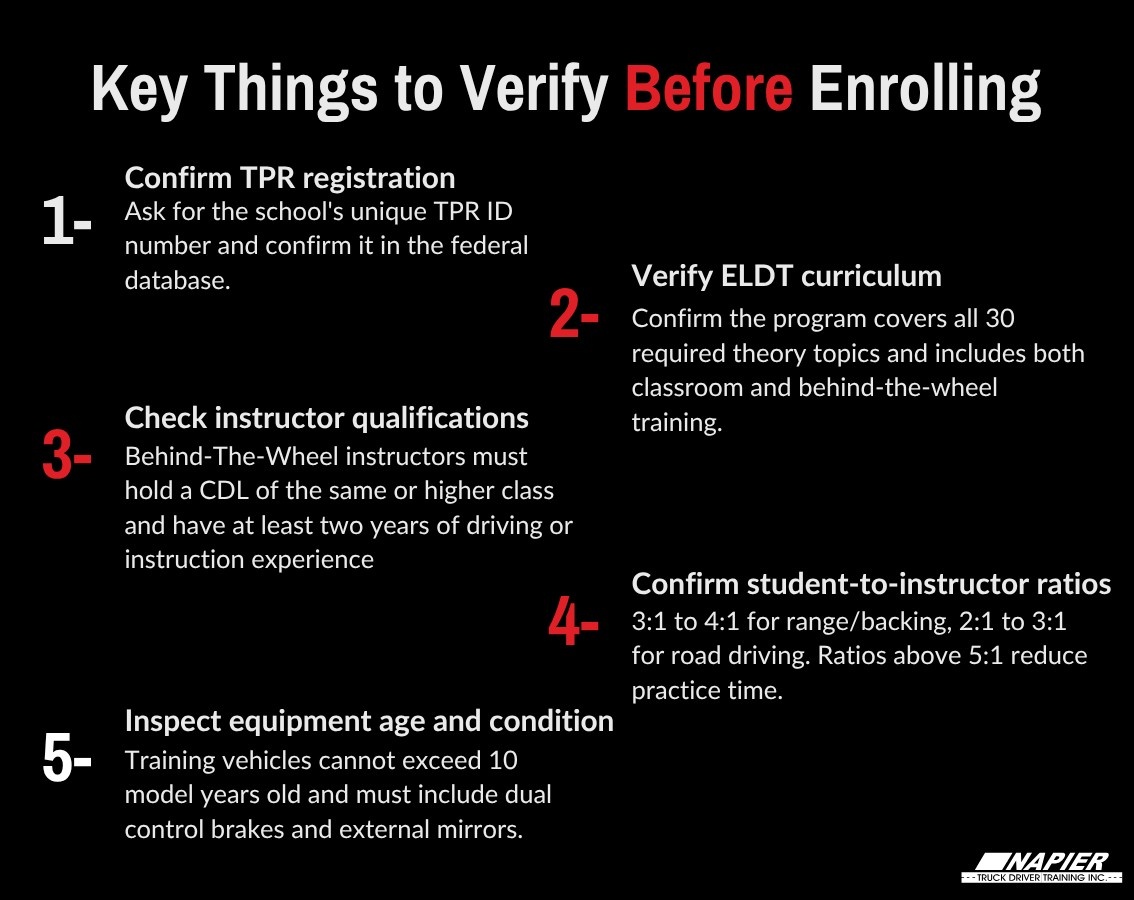
Start by confirming the school is listed on the Federal Training Provider Registry. Only TPR-registered schools can legally submit completion records to state DMVs. If a school is not on the list, it cannot certify training.
Step 3: Identify Red Flags and What to Avoid
Warning signs to watch for
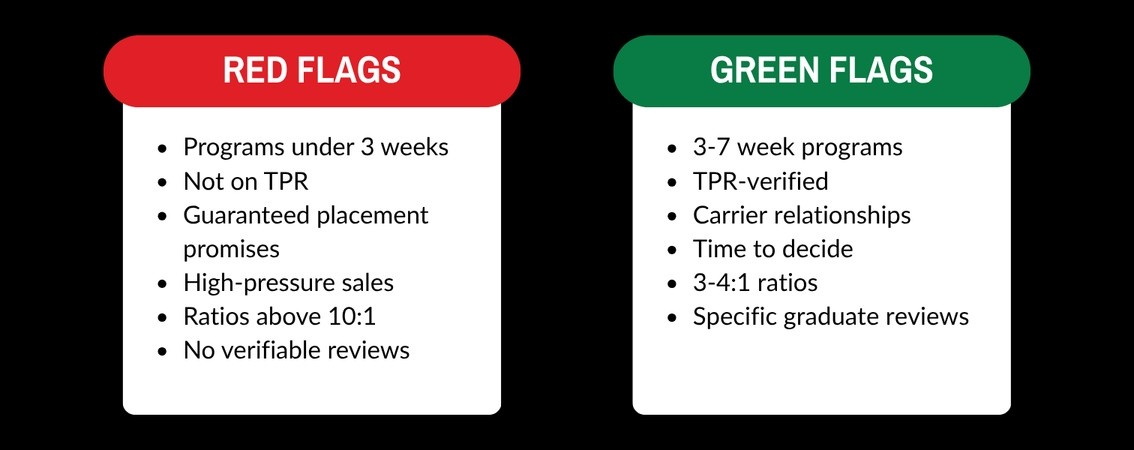
- Unrealistic timelines: Programs advertising 20 days or less focus on test memorization, not real skills. Students may pass the CDL test but fail carrier road tests during orientation.
- Short training hours: Programs under three weeks or 120 hours typically teach test routes instead of actual driving.
- High-pressure sales: Manufactured urgency about expiring deals is a sign the school relies on pressure rather than program quality.
- No online presence: Check Reddit (r/Truckers) and The Truckers Report for real graduate feedback. Vague reviews with generic names are often fabricated.
- Guaranteed placement: No school can legally guarantee a job. Pre-hire letters can be revoked at any time.
Step 4: Compare Programs and Make a Final Decision
Questions to ask every school
- What is the student-to-instructor ratio for range and road training?
- Are manual transmissions available, or is training automatic-only?
- How many behind-the-wheel hours are included in the program?
- Is DMV testing done on-site, and are road test fees included in tuition?
- What is the first-time pass rate, and what support is available for students who need extra practice?
Company-Sponsored vs. Private CDL School
Both paths lead to a CDL, but the right choice comes down to flexibility. Company-sponsored training offers low-cost entry and guaranteed employment in exchange for a 1-year+ commitment, while private school gives students open carrier choice and no employment contract, at a higher upfront cost.
Other Factors to Consider
- WIOA grants and tuition reimbursement may reduce upfront costs at private schools. Always get a written breakdown of all fees.
- Visit the school before enrolling. Watching how instructors interact with students reveals more than any brochure.
- Ask schools to connect prospective students with recent graduates for an honest account of the job placement experience.
Conclusion
Choosing a truck driving school is one of the most important steps in starting a CDL career. Start by confirming TPR registration, ask the right questions, and visit the facility before committing. Quality preparation matters more than a fast graduation date. The school a student chooses today shapes the professional driver they become.
FAQs
Do students need prior driving experience to enroll in CDL school?
No. CDL Schools do not require prior commercial driving experience. Students need a valid driver’s license in the state where they plan to earn their CDL and must meet basic requirements before enrolling.
What is a Commercial Learner’s Permit and does a student need one before starting CDL school?
A Commercial Learner’s Permit (CLP) is required before a student can take the CDL skills test, but. Most schools do not require one before enrollment.
What should a student ask about a school’s CDL exam pass rate?
Students should ask for both the program completion rate and the first-time CDL skills test pass rate. Quality programs typically report pass rates above 80 percent.
What student-to-instructor ratio should a CDL school have?
For backing and range exercises, 3:1 to 4:1 is recommended. Ratios above 5:1 reduce individual practice time and slow skill development.